Downspout flushing: checking that water leaves
A gutter can look empty and still back up. The downspout is where most hidden clogs sit, and flushing it is part of how we clean.
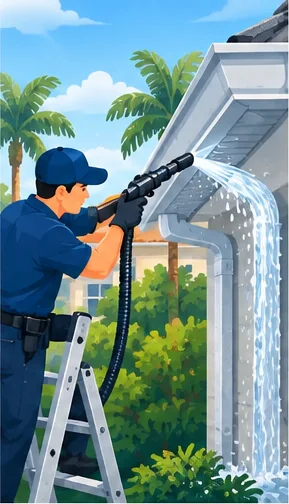
What flushing actually does
Flushing means running water through the gutter and out of the downspout to confirm real flow. For a stubborn plug we may use a hose, a pressure tool or a plumber's-style auger. The goal is simple: water goes in at the roof and comes out at the base, with no gurgling or pooling in between.
Debris that gets past the gutter outlet, such as oak leaf fragments, grit and pollen clumps, tends to wedge in the elbow just below the roof edge. That is the first place to look when water spills over a gutter that seems clean.
Where the water goes next
Windermere sits on an isthmus between Lake Down and Lake Butler, part of the Butler Chain of Lakes. Many properties here are near the water, so the end of the downspout matters as much as the start. We look at where the discharge lands: a splash block, an extension, a buried drain line or a shoreline slope.
If a downspout feeds an underground line, say so up front. We can flush what we can reach, and where a problem sits deeper than that we will flag it so you can bring in another trade. Knowing about it before the visit saves a return trip.
Signs a downspout needs attention
Watch the next heavy rain. A downspout that needs help usually shows one of these signs:
- Water pours over the front lip of the gutter near the downspout while the rest looks fine.
- A stream trickles at the base even in hard rain, which suggests a partial blockage.
- Soil, mulch or sod washed out near the discharge point.
- Staining or algae on the wall below the gutter line.
Describe what you saw in your quote request. It helps us decide what to bring. More on what overflow does to a house is in the guide.
Ready for a quote on your gutters?
Send your details once and we will call to confirm the scope and give you a free quote. You choose whether to go ahead.